

How much does a website cost in the UK?
A straightforward guide to website prices, ongoing costs and planning your budget.
Posted by Natalie Mayes last month
When website quotes vary so much, it can be difficult to know what’s reasonable, what’s included and whether you’ll face extra costs later. You want something that works for your business without paying for more than you need.
This guide explains the typical costs of a new or replacement website, what affects the price and what to budget for after launch.
How much should I pay for a website?
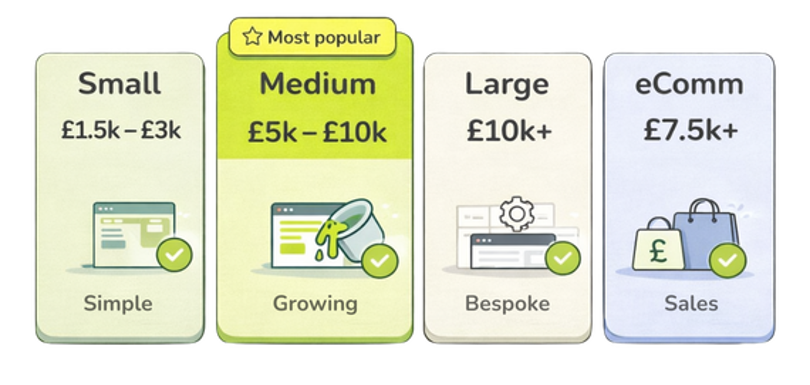
For a professionally designed small business website, £1,500 to £3,500 is a useful starting budget. A larger site with more content and design work may need a budget of £6,000 to £10,000, while more complex projects can reach £10,000 to £20,000 or more.
These are guide ranges, rather than a measured UK average. Website design costs vary because the work involved varies, from a few pages introducing your business to an online shop or a website connected to your other business systems.
At mohunky, our starting prices are:
| Website Type | Suitable For | Starting Price |
| Small business website | A straightforward site introducing your business and services | £1,500 + VAT |
| Custom website | A more substantial site with a bespoke design and more content | £6,000 + VAT |
| eCommerce website | Selling products or services online | £7,500 + VAT |
| Larger or more complex website | Extensive content, customer portals or specialist integrations | Quoted individually |
You can see what’s included in each option on our website prices page. Your final quote will depend on the scope of the work.

What is the average cost of website design for a small business in the UK?
There isn’t one average website price that neatly covers every small business website. A local business explaining its services has different requirements from a retailer selling hundreds of products.
For a straightforward, professionally built brochure website, around £1,500 to £3,500 is a sensible guide. This usually means a small number of pages introducing your business, explaining your services and making it easy for customers to get in touch.
Highlight Accounting and Timeout Boxing are examples of this type of website.
At mohunky, our small business websites start from £1,500 plus VAT. If you need more pages, more involved layouts or additional functionality, our custom websites start from £6,000 plus VAT.
A smaller website should still be well designed and useful to customers. A higher price should reflect the additional scope and work involved, rather than being the only way to get a website that does its job properly.

What should a small business budget for a website?
Your budget should cover getting the website live and keeping it running afterwards. The design and build are the starting point, but it’s worth checking what else you’ll need before committing to a quote.
Alongside the build, consider whether you need help writing the content, sourcing images or arranging photography. If you already have a website, find out whether moving existing pages, products or blog posts is included.
Then allow for hosting, domain renewal and any business email or paid services you need. You may also want to set aside some money for future changes, particularly if you expect to add new services or features.
Check whether quoted prices include VAT. For example, a £1,500 build plus VAT comes to £1,800, before any separately charged services.
You don’t have to include every future idea in the first version. Agreeing what you need now and what can wait can help keep the initial budget manageable, provided the website can accommodate those additions later.
Our website prices page explains the starting options and inclusions, making it easier to see where your project might fit.
How much does an eCommerce website cost?
At mohunky, eCommerce websites start from £7,500 plus VAT.
An online shop involves more than displaying products. Customers need to find what they want, choose the right options and complete their purchase easily. Behind the scenes, you also need a practical way to manage products and orders.
The cost depends on the design, product catalogue, payment setup and any connections to stock management or other business systems.
The Games Bunker and Forestrall are examples of eCommerce websites we’ve worked on. These illustrate the type of work involved rather than the individual project prices.
What affects website design costs in the UK?
The biggest factor is how much your website needs to do. A few pages and an enquiry form involve less work than a large site with customer accounts, booking tools or integrations.
Design also affects the price. Creating bespoke layouts and working through more involved customer journeys takes time, particularly when different visitors need to find different information.
Then there’s content. Having your text and images ready can help keep the project efficient. If you need help writing, organising or moving content from an old website, that work needs to be included in the budget.
Who builds your website makes a difference too. Agencies have different team structures, overheads and levels of service, so it’s worth checking what each quote includes.
At mohunky, we’re a small team based in Clevedon, just outside Bristol. We work with small and medium-sized businesses to build websites that are easy to manage and can develop as their needs change.
Can a cheap website cost more in the long run?
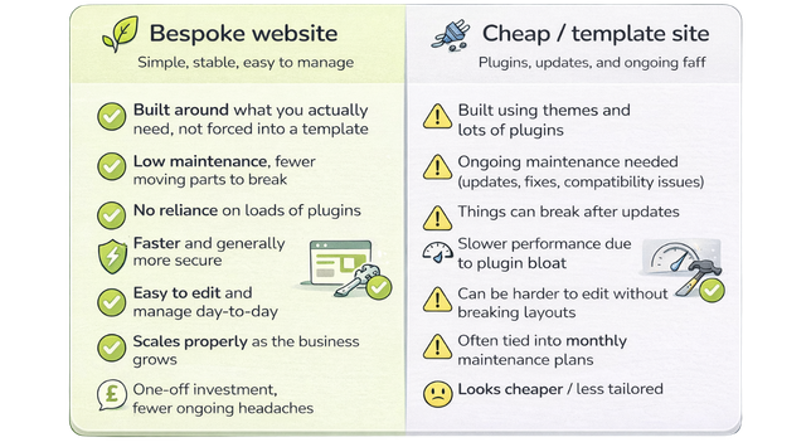
A cheaper website can be a sensible choice when your needs are straightforward. The important thing is understanding what you’re getting and what you may need to pay for later.
A low initial price becomes less attractive if you have to pay for every content change, take out several subscriptions or replace the site when you need a new feature. Building it yourself also has a cost in terms of your time.
Before choosing, check whether you can update the site yourself, what the ongoing charges are and whether it can accommodate the features you’re likely to need.
We’ve seen how much those ongoing costs can matter. In our CHX Performance case study, the business had spent nothing on website maintenance during the three year period covered, beyond its standard hosting and domain fees. Compared with a £65 monthly maintenance plan, that represented an estimated saving of over £2,300.
On a much larger project, we helped a pensions firm reduce its reported annual hosting and maintenance costs from around £100,000 to £1,000, following a £16,000 rebuild. That’s around £99,000 less in recurring annual costs, before accounting for the rebuild investment.
Those are individual examples, but they show why it’s worth looking beyond the initial quote.
Is it cheaper to build your own website?
Building a website yourself can reduce the upfront cost, particularly if you are starting out with a limited budget. Online courses through providers such as Udemy or Coursera can help you learn the basics.
The main thing to factor in is your time. Learning to design and build a website takes effort, and that’s time you could otherwise spend running your business.
Doing it yourself can make sense when money is tight, your requirements are straightforward, and you are happy working within the limits of your chosen template. The difficulty often comes later, when your business needs more from the website or you no longer have time to manage it. Before choosing, consider how easily you will be able to update it and add the features you might need.
That doesn’t mean a lower cost option can’t work. It’s about understanding whether it will suit your needs and how much work you’re comfortable taking on yourself.
For businesses that would rather hand over the technical side, working with a small agency can be a better use of their time and budget.
How much does a website cost per year?
After the build, your yearly costs depend on the hosting, services and support your website needs.
You’ll normally need to allow for hosting and domain renewal. Business email may be charged separately, along with any paid software, integrations or support you choose. Online shops may also have platform charges and payment processing fees.
For a simple illustration, hosting at £32 a month and domain renewal at £15 a year would total £399 a year before VAT, excluding email and additional services. This is a budgeting example, rather than a mohunky package quote.
Ask for the recurring costs alongside the build price so you can compare the first year and the years after it. Check what’s included in hosting and support, and which services would be charged separately. At mohunky, monthly payment plans are available at no extra cost, helping you spread the cost and plan your budget.
Our websites don’t require a monthly maintenance package. We build with ease of management and low ongoing maintenance in mind, and we’re here when you need help with changes or enhancements.
If you don’t have time to update your content yourself, we offer optional support packages to take care of those changes for you. With a minimum charge of just half an hour, you can get help with smaller updates without committing to a larger package.
Whether you need an occasional content change or a technical update, we’ll explain the work and any costs upfront, so you know what to budget for.
How much does it cost to rebuild a website?
The cost of rebuilding a website depends on what needs replacing. A complete redesign and rebuild can involve a similar amount of work to creating a new website, but you may not need to start from scratch.
Our small business websites start from £1,500 plus VAT, custom websites from £6,000 plus VAT, and eCommerce websites from £7,500 plus VAT. A rebuild quote will depend on the existing site, the content you want to keep and any functionality that needs recreating.
If you’re happy with how your website looks but it’s difficult to manage or expensive to maintain, you may not need a redesign.
In many cases, we can keep the existing appearance and replace the system behind it. We use Umbraco for this, giving your team a new way to manage the website while retaining the design your customers recognise.
There’s still development work involved, including moving content and reconnecting features. We’ll assess what can be kept, what needs replacing and any security requirements before recommending an approach.
Can you add new features without rebuilding your website?
Needing a new feature doesn’t necessarily mean paying for a new website. If you want to add a booking system, an online shop or a customer portal, we can often build it into your existing site.
These additions need planning and development, but they don’t automatically mean replacing the whole site. Starting with a flexible foundation lets you invest in what you need today and add more as your business develops.
Noble Decor Hire is a good example of this approach, with its website developing alongside the business rather than needing a fresh start whenever requirements change.
How often should you change your website?
There isn’t a fixed number of years after which a website needs replacing. It’s more useful to look at how well it serves your customers and whether your team can still manage it easily.
Keep your content current as your business changes. A bigger refresh may be worthwhile if visitors struggle to find information, the site is awkward on mobile or it no longer reflects what you offer.
A rebuild becomes more relevant when the underlying technology is unsupported, the site is difficult to maintain or it can’t accommodate the features you need.
Many of the websites we built more than seven years ago are still going strong. A well planned website can evolve through content updates, design changes and additional features, without starting again every few years.
You can read more about how we build websites that can grow with your business.
How do I get a quote for a website?
Start with a short outline of what your business does, what the website needs to achieve and any features you need. If you’re replacing an existing site, explain what works well and what’s causing problems.
You don’t need a detailed technical brief. A few examples, an idea of your budget and a conversation about your priorities are enough to get things moving.
Take a look at our website prices or get in touch and we’ll help you work out what fits.
No pressure, just honest advice.
Read more posts...
How we saved a pensions firm £99,000 a year!
Posted by Natalie Mayes some time ago
Why we’re based in Clevedon
Posted by Natalie Mayes some time ago
Chat to us on WhatsApp
Scan, click or tap the QR code to start a WhatsApp chat.

Let's chat
If you have a specific project in mind, or you’re not sure what you need, please get in touch - we’d be happy to chat, even if it’s just for friendly advice! We’re based in Clevedon, near Bristol and work with businesses across the UK.