

Website care plans: do you really need one?
Keeping your website running smoothly shouldn’t mean paying for more than you need.
Posted by Natalie Mayes today
Do you need a website care plan?
Another monthly payment leaves your account. Your website looks the same, works the same and hasn’t needed any changes. The invoice says “website care plan”, and you find yourself wondering what you’re actually paying for.
That’s a fair question. When you’ve already invested in a website, paying every month to keep it running can feel like an expense with no obvious result.
Sometimes, useful work is happening behind the scenes. Sometimes, the arrangement deserves a closer look.
Website care plans can make sense, but a separate monthly plan isn’t essential for every website. What matters is how your site is built, what it needs, and who takes responsibility for looking after it.
What do website care plans cover?
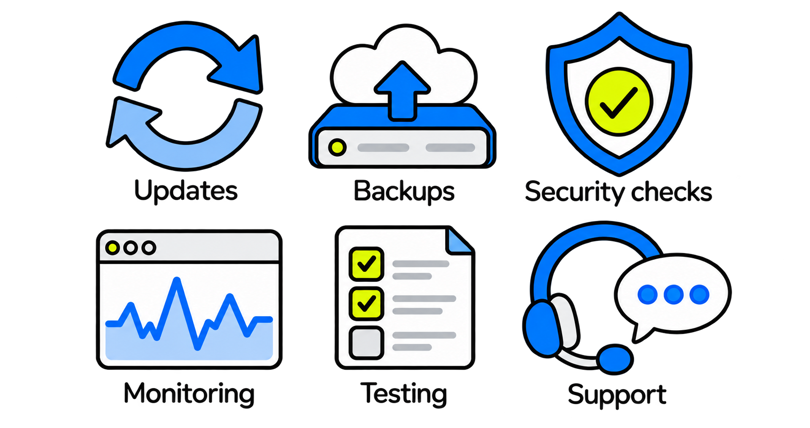
A care plan is an ongoing agreement to maintain your website. The details vary between providers, but it may include:
- Software updates: keeping the website’s core software up to date.
- Plugin updates: keeping your website’s add on features up to date to fix bugs, address security issues and maintain compatibility with the rest of your site.
- Backups: saving copies of your site so it can be restored if needed.
- Security monitoring: checking for known issues and unusual activity.
- Uptime monitoring: monitoring whether your website is online.
- Testing: checking that important features still work after changes.
- Support: helping with problems, questions or small content edits.
Some plans include hosting, paid software licences or a set amount of development time. Others charge for these separately.
That makes the detail more useful than the name. A plan that includes responsive support and regular testing provides a different service from one that simply runs automatic updates.
You should be able to understand what your monthly payment covers without needing a technical background.
Why do some websites need website care plans?
Some websites have more moving parts than others.
A site might use separate plugins for forms, bookings, payments, search and page layouts. Each may have its own updates, and changes to one can affect another. Someone needs to manage those updates and check that everything still works together.
The website’s role matters too. If customers rely on it to place orders or access services, regular checks and a dependable support arrangement can be valuable.
For an owner who doesn’t have an in-house team, a care plan can be a practical way to give that responsibility to someone else.
A quiet month doesn’t necessarily mean the plan was wasted. Maintenance often succeeds by keeping things uneventful. But your provider should still be able to explain the work being done and why your particular website needs it.
What should WordPress care plans include?
If you’ve been comparing WordPress care plans, you’ll probably have noticed that similar descriptions can come with very different prices.
The useful questions are straightforward. Are updates checked before they reach your live website? Are backups available if something goes wrong? Does anyone test your enquiry form? Who fixes a problem caused by an update, and is that work included?
A WordPress care plan can provide worthwhile support when it matches the needs of the site. The platform’s name alone doesn’t tell you whether a particular package offers good value.
Ask for a plain explanation of the service, including its limits. Knowing what costs extra is just as useful as knowing what’s included.
When are website care plans unnecessary?
A website built on a stable foundation may not need a separate monthly care plan.
That foundation includes a sensible choice of software, dependable hosting, appropriate security and only the features the business actually needs. Keeping unnecessary complexity out of the build can reduce the work required to maintain it.
For a straightforward business website, hosting may already cover some routine tasks. Occasional support can then be arranged as needed, provided someone remains responsible for necessary maintenance.
The distinction is between needing care and needing a particular payment model. Every website needs someone accountable for its upkeep. That doesn’t automatically mean every owner needs another monthly subscription.
Before cancelling an existing plan, establish which responsibilities it currently covers and where those responsibilities would move.
How does Umbraco fit into website care plans?
When your website is built on a stable foundation, keeping it running should take less work. That’s one of the reasons we use Umbraco, the software you use to edit and publish your website. A well built Umbraco site is low maintenance, without a constant cycle of fixes to keep everyday features working.
Updates still happen, but they don’t automatically justify 12 monthly payments. Where an update involves around an hour’s work, we can arrange it as a one off job. Larger version upgrades happen less frequently, and we always assess and agree the work involved beforehand.
Smaller, low priority updates can usually be reviewed during an annual website health check. Any security update that needs earlier attention is handled according to its urgency.
That makes routine maintenance one less thing to think about or set aside a monthly budget for. You get a dependable website, with help available when it’s needed and any one off costs agreed beforehand.
What can changing website care plans save?
For one pensions firm, switching away from a care-plan model with a different content management system delivered a £99,000 annual saving on maintaining and hosting an outdated, overly complex website. Their experience shows why it’s worth taking a closer look at recurring website costs - and whether the setup you’re paying to maintain still serves your business.
Every website has different needs, so the savings will vary. When comparing options, look at the whole cost: hosting, licences, maintenance, support and future upgrades. If switching systems means rebuilding your website, include that investment too.
The useful question is whether your current arrangement still makes sense over the life of your website.
Read how the pensions firm saved £99,000 by changing its website setup.
Reviewing website care plans: where should you start?
Start with your current agreement. Ask your provider what work happens each month, which tasks are essential for your site and which services are already included elsewhere.
A clear answer may reassure you that your plan is money well spent. It may also reveal that a simpler arrangement would suit your business.
Wondering whether your website still needs a care plan? Get in touch with the details of your current site and monthly package. We can help you understand what’s necessary and whether a simpler approach could work for you.
Read more posts...
How much does a website cost in the UK?
Posted by Natalie Mayes last month
Why isn't my website getting any enquiries?
Posted by Natalie Mayes last month
Chat to us on WhatsApp
Scan, click or tap the QR code to start a WhatsApp chat.

Let's chat
If you have a specific project in mind, or you’re not sure what you need, please get in touch - we’d be happy to chat, even if it’s just for friendly advice! We’re based in Clevedon, near Bristol and work with businesses across the UK.