

Why isn't my website getting any enquiries?
Posted by Natalie Mayes last month
Your website looks fine. It explains what you do, has a contact page and seems to work when you check it. But the enquiries aren’t coming in.
That’s frustrating, especially if you’ve already spent time and money getting it right. It can also leave you wondering whether you need to start again.
Often, you don’t. A website not getting enquiries may have a few specific problems that can be fixed within the site you already have.
The first step is to work out where people are getting stuck.
Website not getting enquiries?
Before making changes to your website, check whether enough potential customers are actually finding your website.
There’s a difference between a website that gets very few visitors, and a website that gets visitors, but never make contact. They need different fixes.
Your website’s visitor reports can show which pages people visit most and where they come from. Google Search Console can help you see whether your pages appear in Google, what search terms are made by users that bring them up, and whether people actually click through.
You don’t need to understand every chart in Google Analytics, just start with three questions:
-
Are people visiting the pages that explain your services?
-
Are they finding you through relevant searches, or mostly searching for your business name?
-
Do those visitors match the customers you want to attract?
If hardly anyone finds your services, a new contact button won’t solve the whole problem. If relevant visitors are already arriving, look at what happens next.
Your website may be slow to load
A slow website makes people wait before they’ve even seen why your business is worth their time.
You might not notice it yourself. You know where everything is, and your browser may already have parts of the site saved for quick loading but, someone visiting for the first time can have a different experience.
How to tell: Open a few important pages on your website using an incognito browser. Pay attention to when you can actually read and use them. Does the main image take a while to appear? Does the page jump around? Is there a delay when you click a button or open a menu?
A performance check can help you investigate further. It can show how quickly the main content appears, whether the layout shifts as it loads and what might be slowing things down.
Check more than the homepage. Your main service pages and contact page matter too.
Try our free website scan tool to get started. We can help you understand the results, explain what they mean for your visitors and work out which changes to tackle first.
What fixes it: Common improvements include reducing oversized images, removing unnecessary scripts, improving how pages are delivered and loading less important content later.
These changes can often be made without changing the design. Once they’re complete, testing again under the same conditions helps show what has improved.
A higher speed score is useful evidence of technical improvement. It doesn’t guarantee more enquiries, so we also check how the site feels to use and track whether more visitors get in touch.
Your website might be difficult to use on a phone
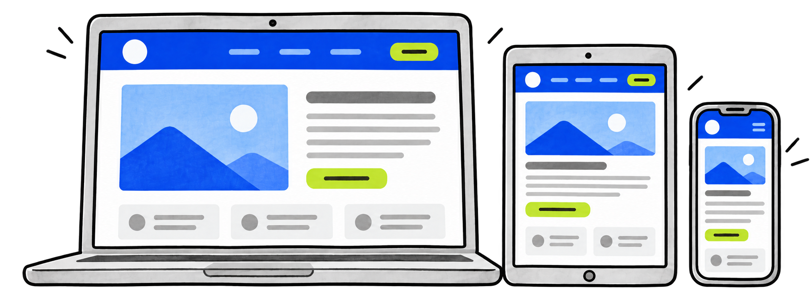
A website can look and work perfectly well on a large screen but be difficult to use on tablets and phones.
Many websites automatically adjust to smaller screens, but they still need checking. Fitting everything on the screen doesn’t always make it easy to use.
Text may be hard to read. Buttons may sit too close together. A large banner might push useful information out of view. Filling in an enquiry form might take more effort than someone wants to give between other tasks.
How to tell: Use your phone to complete a normal customer journey. Find a service, read enough to decide whether it suits you, then make an enquiry. If possible, try it on a tablet too.
Better still, ask someone unfamiliar with the site to try it. Watch where they hesitate without telling them where to tap.
What fixes it: Clearer layouts, readable text, well spaced buttons and shorter forms can make things easier. Make phone numbers tappable and check that menus and forms work comfortably on a small screen.
The aim is to make the useful parts easy to reach with as little friction as possible.
People may not know what to do next
You know what happens after someone contacts you. A first time visitor doesn’t.
They may be wondering whether you offer the service they need, whether their project is too small or whether getting in touch commits them to something.
A vague “Learn more” button may leave those questions unanswered.
How to tell: Look at your main service pages. Is there a clear next step at the point someone might be ready to act? Does it explain what they can expect?
Talking call to actions such as “Discuss your project” or “Request a quote” can be more useful than a general instruction, provided it describes what actually happens.
What fixes it: Give the visitor a clear next step and what they can expect. For example:
“Tell us what you need help with. We’ll review your enquiry and get back to you to discuss the options.”
Only promise a response time if you can reliably meet it. Keep the form focused on what you need to begin the conversation.
Your content may leave people unsure
If your website has old information or doesn’t clearly explain what you offer, visitors may be unsure whether you can help them.
Perhaps you offer a service that barely gets a mention. Perhaps the team details are wrong, or the examples no longer reflect your work. Sometimes the wording sounds professional but never quite explains what the business does.
Visitors shouldn’t have to piece that together.
How to tell: Read your key pages as though you know nothing about the business. Can you quickly understand:
-
What you do and who you help?
-
Whether you cover the visitor’s area or type of project?
-
Why someone should feel comfortable contacting you?
-
What happens next?
What fixes it: Update the pages people use to make decisions. Explain your services clearly, answer common questions and include relevant examples of your work.
Specific details help people judge whether you’re a good fit. A useful project example or a customer’s testimonial of working with you gives them more to go on than broad claims about quality.
Your website may be hard to find in Google
Your website might appear when you search for your business name but be difficult to find when someone searches for what you offer.
That matters because potential customers most likely need your services without knowing your name.
How to tell: Check which searches bring people to your site using Google Search Console. Look at whether your important service pages appear and whether the search terms match the work you want.
What fixes it: Give your main services clear, useful pages. Think about the words and phrases your customers might search for when they need your help. Use these naturally to explain what you offer, and make those pages easy to find through your navigation.
Technical problems can also stop pages from appearing in search. Checking that search engines can access and index your important pages can help uncover issues that need fixing.
There’s no guaranteed shortcut to more enquiries from Google. Start by making sure your service pages can be found and answer the questions a potential customer has.
Are your contact forms working properly?
Sometimes someone has tried to get in touch, but the message never arrives where you expect it.
Forms can fail, notifications can go to an old address and genuine messages can end up in spam.
How to tell: Send a test enquiry from your phone and another from a computer. Check that the visitor sees a confirmation and that the message reaches the person responsible for replying.
What fixes it: Correct the delivery settings, repair any form errors and make the confirmation clear. Give visitors another way to contact you if they need one.
It’s a small check, but worth doing before spending money attracting more visitors. Repeat it regularly, especially after website updates or changes, as these can sometimes affect how forms work or where enquiry messages are sent.
Can you get more website enquiries without a redesign or rebuild?
If your website isn’t converting visitors into enquiries, it doesn’t mean you need to start again. There may be plenty that already works well, with a few problems getting in the way.
Slow pages, an awkward form, unclear service information or a missing next step can often be improved within your existing website. A review can help you understand what’s working, what needs attention and where to focus your budget.
Start with one important service page. Check how people find it, how it works across different devices, what it tells them and how easily they can contact you. Make the most useful changes first, then track whether more visitors get in touch.
Give those changes time to show results. Some improvements will make the website easier to use straight away, but it can take longer to see a difference in enquiries or search visibility. If your website gets fewer visitors, you may need a longer period to judge what’s working.
If a redesign or rebuild would be worthwhile, those checks will help explain why and what it needs to achieve. Either way, you’ll have a clearer plan for moving forward.
If your website looks fine but isn’t bringing in enquiries, get in touch for a website review. We’ll help you understand where people may be getting stuck and which improvements are worth making first.
Read more posts...
How much does a website cost in the UK?
Posted by Natalie Mayes last month
Custom .NET Asset Management Software for Dolphin Lifts Western
Posted by Natalie Mayes last month
Chat to us on WhatsApp
Scan, click or tap the QR code to start a WhatsApp chat.

Let's chat
If you have a specific project in mind, or you’re not sure what you need, please get in touch - we’d be happy to chat, even if it’s just for friendly advice! We’re based in Clevedon, near Bristol and work with businesses across the UK.